
You are here
Marcellus Shale Press Coverage
Secondary tabs
Constitution Pipeline to Take Legal Action

BINGHAMTON, N.Y. -- "Shock. I was stunned. I literally couldn't believe it. I was enormously relieved," said Toxics Targeting President Walter Hang.
It's a feeling many clean energy advocates shared in the wake of Friday's decision regarding the Constitution Pipeline.
The state DEC rejected the water quality certificates needed to move the project forward. Members of Citizen Action of New York believe their message was heard loud and clear.
"It was an incredible organizing effort that helped make this happen," said Isaac Silberman-Gorn, Citizen Action of NY community organizer, "and open the door for the governor to look at the signs, look at the real impacts and do the right thing and really lead the country."
Developers say they were taken aback by Friday's decision, saying "We worked in good faith with the NYSDEC for years, so this decision comes as a surprise and is contrary to our dialogue and collaborative effort to address concerns."
Denying the project will prevent more than 700,000 trees from being cut down and prevent more than 100 homes from being demolished. But opponents of the pipeline say their battle is long from over.
Constitution Pipeline announced Monday that they remain committed to the project and will pursue legal action, saying, "We believe NYSDEC’s stated rationale for the denial includes flagrant misstatements and inaccurate allegations, and appears to be driven more by New York State politics than by environmental science."
"The fracktivists who have been working so hard to make sure the Constitution Pipeline didn't proceed are not in any way going to take our foot off the pedal. We're going to keep pushing," said Hang.
Pipeline developers claim more than 2,000 direct and indirect jobs and millions of dollars of revenue for the region will be delayed. Now people on both sides will prepare for the next stage of the debate, likely in a courtroom.
Hundreds Rally For Constitution Pipeline

BINGHAMTON, N.Y. -
The battle over the Constitution Pipeline continues. This afternoon hundreds rallied in favor of the project in downtown Binghamton.
The 124-mile pipeline would carry natural gas from Susquehanna County, Pennsylvania to Schoharie County in New York. However, the state has until the end of the month to grant what's called a Section 401 Water Quality Certification for the project to move forward. Opponents say the state can't guarantee the pipeline won't effect water quality, and therefore can't grant the certification.
Broome County Executive Debbie Preston, who supports the pipeline, says the project would lead to 2,400 direct or indirect jobs in the Southern Tier and $2.1 million in tax revenue to Broome County.
"Everyone needs to understand how much communities, landowners, and businesses in the Upstate New York area need the Constitution Pipeline. It's basic infrastructure that is necessary to move natural gas and it's what we live on," said Scott Kurkoski, attorney for the Joint Landowners Coalition of New York.
"Thousands of people have written Governor Cuomo stating the Water Quality Certification for the Constitution Pipeline must be denied because the state simply lacks the ability to fulfill the onerous requirements of the Clean Water Act," said Walter Hang, President of Toxics Targeting
A spokesperson for the Constitution Pipeline has said the project will use the latest technology to ensure it's safety. If the state does nothing by the end of the month the ability to move the project forward would go to the Federal Energy Regulatory Commission, which has already approved the pipeline.
Protesters arriving at Chelsea Clinton event in Ithaca
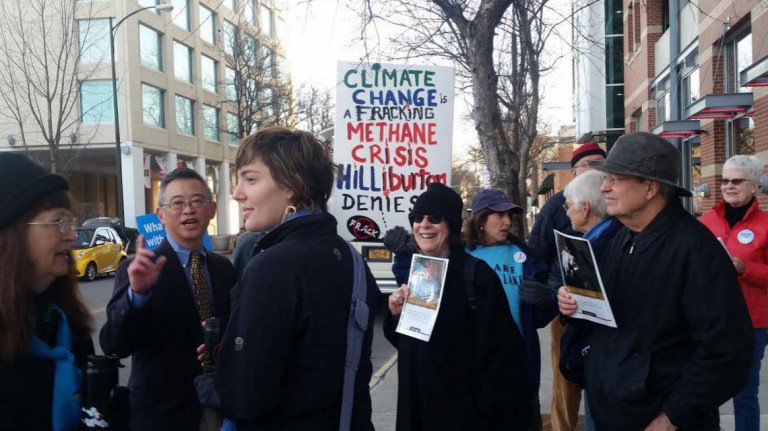

Photo by Jolene Almendarez/The Ithaca Voice
ITHACA, N.Y. -- Protesters from several organizations have begun arriving at Coltivare Restaurant in downtown Ithaca to protest presidential candidate Hillary Clinton's stance on various national issues.
Many of the supporters -- about two dozen and growing as of about 7:30 a.m. -- said they are representing various groups from the Tompkins County area.
"It's not really a Sanders rally," said protester Richard Franke, though he said many of the protesters would likely vote for presidential candidate Bernie Sanders.
He said he was at the rally to protest Hillary Clinton's foreign policies.
"Her judgement on Middle East issues has shown, again and again, to be very faulty," he said.

Photo by Jolene Almendarez/The Ithaca Voice
Specifically, he and fellow protester Barbara Chasin, from the town of Ithaca, said they are against the drone program and civilian casualties from bombings in the middle east.
Chasin added that the two are also against Clinton's "uncritical support or Israel."
Anti-frackers and people who want to encourage the United States' move away from dependence on fossil fuels are also turning out in huge numbers.
Theresa Alt, who currently lives in Collegetown but has resided in the area for almost 40 years, said she is at the event to raise awareness about the different take on such issues between Clinton and Sanders.
"The important thing is us getting this county off fossil fuels as fast as possible," she said. "There's a real difference (between candidates) on this extremely central issue."
She said Sanders has advocated for the elimination of fracking while Clinton has called for more strict regulation, instead.
Sanders wins support from New York's climate movement

NOTE: The following news article is in Danish. An English translation follows.


English translation of above
Until recently has climate politics not played an important role in the Democrats' primary elections. But it is in New York's primary election, where a grassroots movement is closing around Bernie Sanders's demand for a nationwide ban on fracking.
(Picture caption)
Bernie Sanders has broad support among the climate movement, among other things as a follow-on to his opposition to fracking and the fossil energy industry. Here the demokratic candidate meets voters in Syracuse, New York, where there is a primary election on Tuesday.
Five years ago everything pointed to that that state of New York would follow other states' track and five energy companies permission to extract natural gas from "skifer"?-layers in the onetime industrial city Binghamton with help of the controversial and potentially very environment-damamging technique of fracking.
The local climate activist Adam Flint had together with several others in Binghamton just started the non-profit group Southern Tier Solar Works, that had as its purpose to promote green energy sources and ecological land use.
"We understood immediately that fracking in this nature-beautiful part of New York would carry a large risk for pollution of the ground water and air and other things like gas explosions. So we laid our plans on ice and began to fight fracking," explains Flint.
Some few activists' opposition to fracking developed in short order to a grassroots movement of 'fracktivists' all over the northwest corner of the state of New York, that stretches from Pennsylvania in the south to the border of Canada in the north.
The movement became carried further by the activist Walter Hang, whose group, Toxics Targeting, for years had brought the state authorities' lacking assurance against pollution of groundwater and other types of industrial pollution into the light of day.
"We could document a long list of examples through the years that neither the political authorities or those responsible in industry had done sufficient to stop pollution and clean up after," relates Walter Hang from his office in the university town Ithaca.
The development of natural gas from the Marcellus Shale layer in this corner of New York would with certainty lead to more pollution and more industrial accidents.
After some years the movement of 'fractivists' scored giant victory. Governor Andrew Cuomo declared in a speech the 17th of December, 2014 that he would declare a ban on fracking for the whole state.
A national ban
That was the first and up to now the only time that an american state has laid down a ban against fracking. In the rest of the USA is fracking permitted. In the north of Pennsylvania - an hour's car drive from Binghamton - one can find 7000 bore holes. Many of them are today unused, because the price of natural gas has fallen abruptly in later years.
Adam Flint remembers that day, when governor Cuomo communicated his decision. "It was unimaginable, that we had won," says he.
Flint tells his story, shortly after senator Bernie Sanders has spoken to 5000 people in an indoor stadium Monday morning in Binghamton.
The democratic presidential candidate is received with an ear-deafening greeting, that could raise the roof over the sports hall. The next-largest applause is given to Sanders's promise that he as president would issue a declaration that bans fracking in all USA's 50 states.
The democratic socialist, that regularly thunders against the fossil energy industry and "matadors" on the Wall Street stock exchange, has in his opposition against fracking found a topic that wakes a grassroots movement to action in that part of New York.
Polls show that Sanders is well behind Hillary Clinton in New York City and its surroundings, but he stands equal with her in the northern part of the state, that is also called Upstate New York.
But in 'upstate' one finds only a third of the democratic voters, so unless Sanders's most loyal voter group, the young americans, in a very large number stream to the ballot box in the city during the primary election Tuesday of next week, it will be impossible for him to beat Clinton.
New York is a state that Sanders must win, if he is to have a chance to catch up to Clinton's lead in the delegates to the party congress in July.
For that reason, Sanders in the beginning of this week held voter meetings in Upstate New York, where he in three large cities attracted 10-15000 people. The last couple of days he and Clinton have spent in New York City. Wednesday evening 27000 voters met up at a meeting with Sanders in Washington Square Park on Manhattan - a record.
In the same park by New York University, Barack Obama had 20000 onlookers during the election battle in 2008. Clinton's voter meetings encompass seldom more than a couple thousand people.
Clinton's strength
Even in Binghamton is is far from certain, that Sanders will win. The city has through several decades lost thousands of jobs in industry, that have moved to the south states and later to Mexico and Asia. Unemployment and poverty - especially among black families - is still higher than average for New York.
"Hillary stands pretty strong in this part of New York, because many democrats are of fairly moderate persuasion, and her support from black voters is large. She did what was possible, politically seen, to improve our economy, as she was New York's senator from 2001 to 2009," says Binghamton's earlier democratic mayor Matt Ryan.
In spite of that is Ryan himself a fervent supporter of senator Sanders.
As mayor of Binghamton until 2013 Ryan attached himself completely unexpectedly to the grassroots movement against fracking, with great risk for his political career.
"But after having informed our city residents carefully about the danger of fracking, we were successful according to the pools to get a half over on our side. We could among other things point to how destructive fracking has been for the environment in Pennsylvania in the last five years," explains the ex-mayor.
Perhaps the most decisive breakthrough for the movement against fracking came in 2014, when the unknown law professor Zephry Teachout from Fordham University in New York City ran against governor Cuomo in the democratic primary election and won 33 percent of the votes.
"That was a shock for the governor. He won 1 million fewer votes in Upstate New York compared to the primary election in 2010. A large part of Zephyr Teachout's voters were democrats, that sympathized with the movement against fracking," says Walter Hang from Toxics Targeting.
Letter to the candidates
The surprising support for the unknown democrat, that was up against a relatively popular governor, can be explained with Teachout's decision to back up the movement's demand on a ban against fracking.
"In the beginning of the campaign she knew only a little on the environmental consequences of fracking involved in the extraction of natural gas in the shale. But we educated her in the subject and arranged a lot of voter meetings. That bore fruit," explains Hang.
In connection with the primary campaign in New York has Toxics Targeting in a letter requested all presidential candidates for a promise to support a nationwide ban against fracking. Up to now no one has answered.
"That confirms that neither Clinton nor Sanders are willing to go so far. What we hear from Sanders is just political chitchat," says Walter Hang.
But there is an important difference between the two democratic presidential candidates. During the campaign has Clinton's environmental stance become more progressive.
She has turned against the oil pipeline Keystone XL and oil drilling near USA's coast and has said that she as president will tighten the regulation of fracking technique to such a level, that "fracking will only take place few places in the USA."
Sanders has in contrast without condition blessed the american climate movement's demand for a phasing out of the the fossil energy industry in the USA. Climate activists therefore trust in him. In contrast, they don't in Clinton.
| Attachment | Size |
|---|---|
 Information.dk-4-15-2016-Sanders-Fracking.pdf Information.dk-4-15-2016-Sanders-Fracking.pdf | 360.19 KB |
